

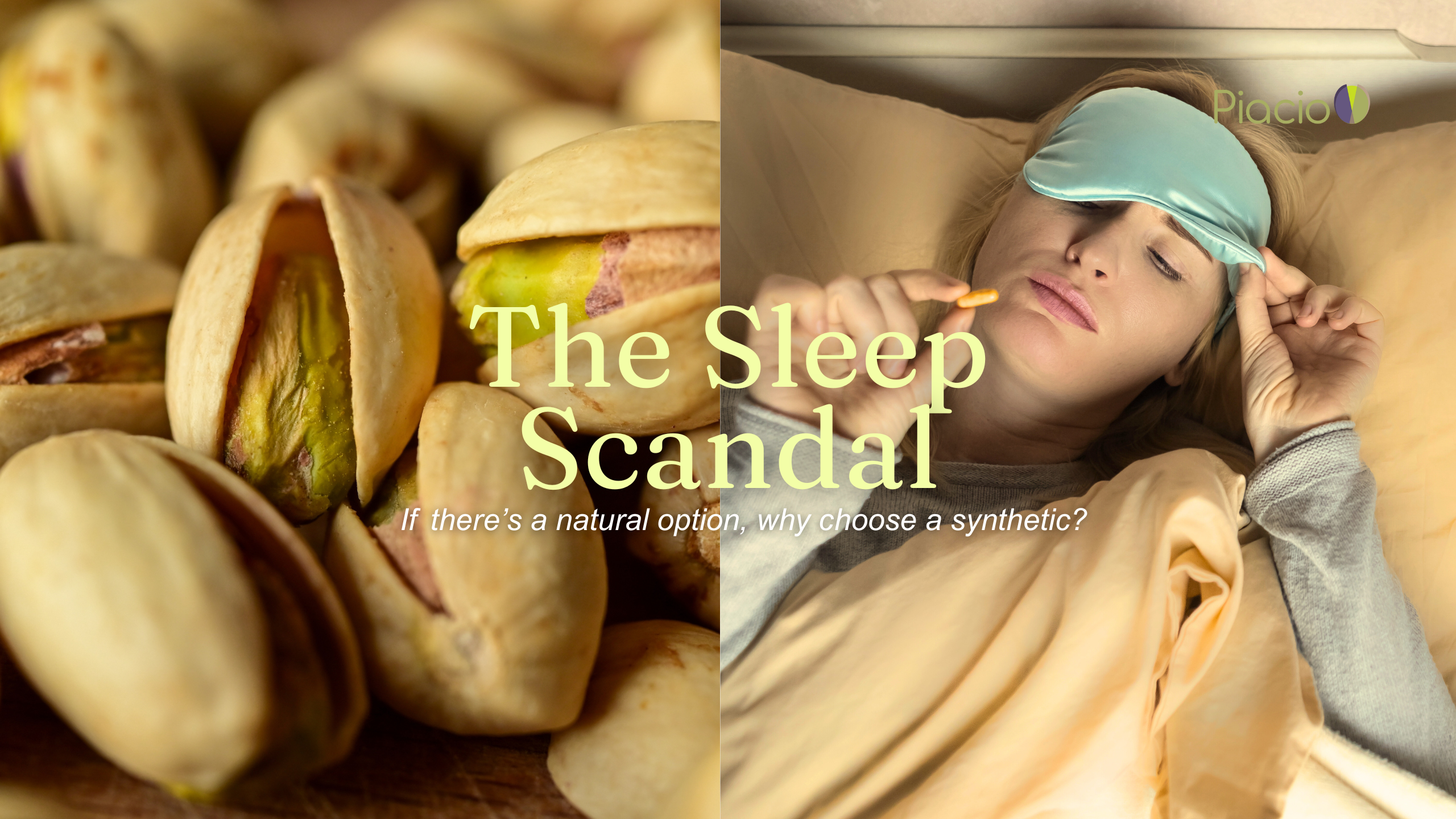
In the world of sleep supplements, synthetic melatonin has long held the crown. But emerging botanical science introduces a fresh contender: pistachio extract, which not only contains melatonin but also appears to potentiate melatonin receptor signaling. This dual action puts pistachio extract in a exclusive category—not just a “natural melatonin,” but a scientifically differentiated botanical candidate that may compete or complement synthetic formulations.
In this post, we’ll explore:
- The mechanism and clinical use of synthetic melatonin
- How pistachio extract works and why it’s promising
- Preclinical evidence and limitations
- A balanced comparison of pistachio vs. synthetic melatonin
- How Piacio® can bridge the gap to real-world, high-integrity pistachio-derived sleep ingredients
I. Synthetic Melatonin: a stable benchmark
i. What is synthetic melatonin and how is it used?
Melatonin (N-acetyl-5-methoxytryptamine) is a natural indoleamine hormone secreted by the pineal gland at night, regulating the circadian rhythm and promoting sleep onset. Synthetic melatonin is chemically manufactured with high purity to mimic this endogenous compound. It’s widely used for insomnia, jet lag, shift-work sleep disorder, and certain circadian rhythm disruptions.
Because synthetic melatonin is consistent in dose and purity, it serves as a benchmark in sleep studies. Its pharmacokinetics, receptor binding, and safety profiles are relatively well understood in short-to-medium term use
ii. Strengths and limitations of synthetic melatonin
Nearly all over-the-counter melatonin is synthetic. Manufacturers chemically produce it through multi-step organic synthesis instead of extracting it from animals or plants. People widely use synthetic melatonin to manage insomnia, circadian rhythm disorders (such as jet lag, delayed sleep phase, and shift work), and sleep issues in specific groups like blind individuals with non-24-hour sleep–wake disorder. In most countries, regulators classify synthetic melatonin as a dietary supplement rather than a drug, which subjects it to less strict oversight than prescription sleep medicines. Supplement doses typically range from 0.1 mg to over 10 mg, though lower amounts are often effective.
iii. Pros of synthetic melatonin:
- Dose control & consistency: each tablet or capsule can deliver an exact mg quantity.
- Regulated supply chains: chemical manufacturing methods are mature, scalable, and well-documented.
- Proven clinical evidence: multiple trials and meta-analyses confirm benefit over placebo in improving sleep quality, latency, and circadian alignment.
iv. Cons / challenges:
- First-pass metabolism & variable bioavailability: different individuals absorb and metabolize melatonin differently, producing variable systemic levels.
- Potential side effects: residual drowsiness, headaches, dizziness, daytime somnolence in some users.
- Overuse and tolerance concerns: long-term use data is limited.
- Consumer perception issues: some users prefer “natural” alternatives over synthetic chemicals.
- Quality control risks: mislabeled or impure products abound in unregulated markets.
Thus, synthetic melatonin is reliable but not perfect—hence the allure of a botanical alternative that maintains or improves on efficacy and safety while delivering differentiation.
II. Consumer trends & demand: why pistachio extract is appealing
Pistachio extract doesn’t merely mimic synthetic melatonin—it potentially amplifies it. Several scientific findings make this an exciting prospect.
i. Mechanistic evidence: potentiation of melatonin signaling
A foundational paper in Pharmaceutics (2023) evaluated 25 plant extracts using a battery of assays: radioligand binding (2-[125I]-iodomelatonin), cAMP inhibition, ERK1/2 activation, and β-arrestin2 recruitment, using HEK293 cells transfected with MT₁ or MT₂ receptors. One standout was Extract 18 (Ex18), derived from dried Pistacia vera fruit. Key findings:
- Ex18 had exceptionally high endogenous melatonin content: 5.28 ± 0.46 mg/g extract.
- Ex18, when co-applied with melatonin, potentiated melatonin’s signaling through G-protein–dependent pathways (cAMP inhibition, ERK activation), but did not potentiate β-arrestin2 recruitment. This indicates a functional selectivity or biased signaling effect.
- The authors concluded that Ex18 not only donates melatonin, but contains additional “active principle(s)” that enhance melatonin receptor signaling selectively.
In short: pistachio extract appears to bring more than just melatonin—it may act as a melatonin amplifier in certain cellular pathways.
ii. Animal evidence of sleep enhancement
A 2025 study in Pharmacognosy Research tested a pistachio extract standardized to 1% melatonin in a pentobarbital-induced murine sleep model.
- Doses: 100, 200, 300 mg/kg (each formulation containing 1% melatonin).
- Results: All doses reduced sleep onset time and prolonged total sleep duration in a dose-dependent way.
- 100 mg/kg → onset 6.13 ± 1.05 min, duration 93.4 ± 4.48 min
- 200 mg/kg → onset 5.89 ± 1.2 min, duration 104.67 ± 4.80 min
- 300 mg/kg → onset 5.58 ± 1.4 min, duration 109.48 ± 4.66 min
- Effects were statistically significant vs control.
These results show in vivo sedative/hypnotic potential, though the pentobarbital model is additive (i.e., the extract aids but does not itself induce sleep).
iii. Quantitative melatonin levels in pistachios and extraction nuance
While the extract Ex18 contains high melatonin, raw pistachio nuts contain far less. For instance:
- A spectrofluorimetric / GC-MS investigation confirmed the presence of melatonin in pistachio kernels via methanolic extraction.
- Another survey of commercially available pistachio kernels measured ~69.4 ± 3.8 ng/g (i.e. ~1.7 µg in 25 g) in edible nuts.
- By comparison, typical melatonin supplements contain 0.1–10 mg per dose—many orders of magnitude higher than raw pistachio input.
- The American Pistachio Growers reported ~660 ng melatonin per gram of pistachio (raw & roasted).
Thus, potency in raw nuts are modest; achieving effective doses typically requires concentrated extraction and standardization.
III. Why pistachio extract is a novel but promising sleep ingredient
i. Amplification, not just substitution
The notion that pistachio extract simply replaces synthetic melatonin is too modest. The more exciting hypothesis: it may enhance melatonin’s effect via auxiliary active compounds. The functional selectivity seen in Labani et al. suggests the extract may push signaling into more efficacious pathways (G-protein) while avoiding side-effect pathways (β-arrestin2).
If that holds in humans, you might use lower doses of melatonin or deliver more effective receptor activation per mg.
ii. Botanical branding and consumer preference
Many consumers prefer “plant-based,” “natural,” or “whole-ingredient” alternatives, especially in sleep and wellness categories. A well-validated pistachio extract offers narrative power: “sleep support derived from a familiar nut, enriched in nature plus scientific edge.”
iii. Traceability and authenticity justification
Unlike synthetic melatonin (which may be questioned for purity or adulteration), botanical melatonin can be authenticated via techniques such as Stable Isotope Ratio Analysis (SIRA). Some published commentary notes that chemically identical molecules from botanical vs synthetic sources can be distinguished by isotopic signatures.
This gives Piacio® a way to credibly assert “naturally derived” in a way synthetic producers can’t easily mimic.
iv. Synergy with nut-derived cofactors
Pistachios are rich in magnesium, antioxidants, polyphenols, vitamins, and nutrients that support the nervous system and oxidative balance. These may provide background support synergistic to melatonin’s effect—though their contribution must be scientifically quantified. Thus, the extract might deliver a broader “sleep-support matrix,” not just melatonin.
IV. Conclusion: Optimism grounded in science and rigor
Pistachio extract stands out as a novel, scientifically promising natural alternative to synthetic melatonin. Its key differentiators include its melatonin content and its potentiation of melatonin receptor signaling. Animal data reinforce sedative potential.
Yet the path to mainstream adoption requires bridging gaps in human trials, dose standardization, safety validation, and cost scalability. That’s exactly where a credible, rigorous manufacturer must lead.
For brands seeking to offer bold, botanical-first sleep solutions, Piacio® can be that trusted partner: curating high-integrity pistachio-derived melatonin extracts, stamping them with analytical proof, and helping you build differentiated, high-trust sleep products.
References
Labani, N., Gbahou, F., Noblet, M., Masri, B., Broussaud, O., Liu, J., & Jockers, R. (2023). Pistacia vera Extract Potentiates the Effect of Melatonin on Human Melatonin MT1 and MT2 Receptors with Functional Selectivity. Pharmaceutics, 15(7):1845.
Shivaprasad, H. N., Thimmannagari, S., Mariswamy, T., Sree Ramya, C., Krishnamani, M., & Soni, G. (2025). Evaluation of Pistachio Extract Standardized to 1% Melatonin on Pentobarbital Sodium-Induced Sleep in Swiss Albino Mice. Pharmacognosy Research, 17(2).
Comprehensive review: “Melatonin as a promising nutritional and therapeutic molecule” (2024). (ScienceDirect)
Healthline. Do Pistachios Contain Melatonin? Retrieved from https://www.healthline.com/nutrition/pistachios-melatonin
American Pistachio Growers: Press releases study
Castillejo, A. et al. (2025) Synthetic Melatonin and/or Phytomelatonin Contents in Different Supplements. Retrieved from https://www.mdpi.com/1661-3821/5/2/9
Leave a Reply